
Live Casino UK: How Online Tables Work
 Available in GB
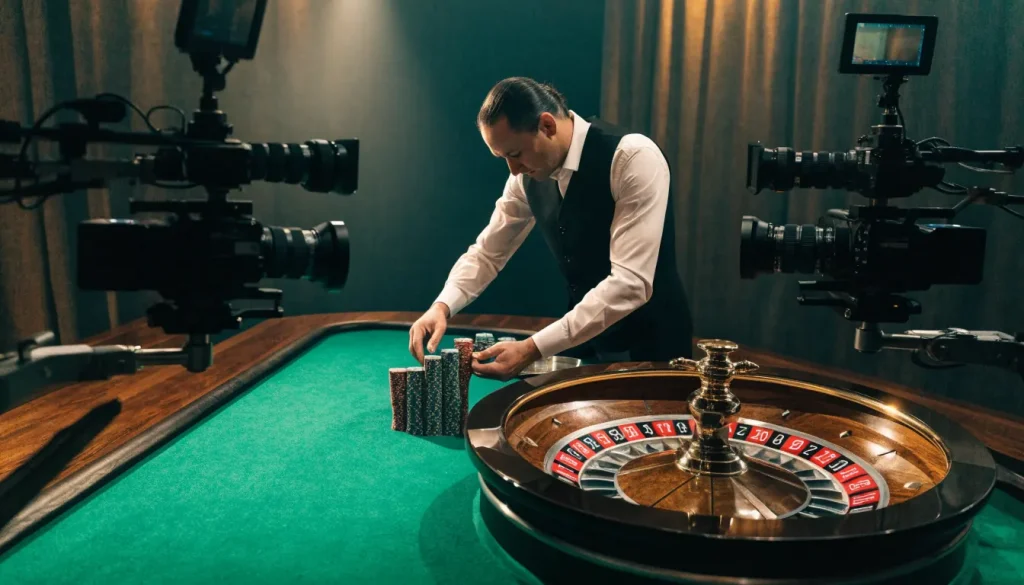
A live casino pairs a physical table broadcast with on-screen controls, while the lobby brings tables and game formats together.
Table of Contents
- Live Casino Online: The Broadcast Behind the Table
- Playing Live Casino for Real Money
- Live Casino in the UK: What the Label Does and Doesn’t Tell
- Casino Sites, Licences and the Limits of a Search
- The Dealer Is Part of the Interface
- Blackjack and Baccarat: Table Rules, Not Table Mystique
- Live Casino Games and the Shape of the Lobby
- Live Casino Bonuses: The Arithmetic Behind the Welcome
- No-Deposit Offers and the Small Print
- Poker, Offers and the Screen Shared With the Table
Live Casino Online: The Broadcast Behind the Table
An online live casino begins with a familiar scene made remote: a dealer, a table and the equipment of a casino game, carried by a video stream into a digital lobby. The player does not sit opposite the dealer. Instead, the table appears on a screen, alongside controls through which decisions can be made. The arrangement is not simply a recording of casino life. It is a live exchange, with the broadcast connecting what happens at the table to what a remote player can see and do.
That connection changes the meaning of the picture. In a conventional digital game, the screen presents a game produced by software. In a live format, the image shows a physical table in motion: cards are handled, a wheel turns, chips are arranged. The stream supplies the visible events on which the game depends. The interface, in turn, allows remote participation in those events. Remove either part and the format changes. A table without a stream is inaccessible at a distance; a stream without a way to take part is only a programme.
Choosing a live casino in the UK means considering not only the games but also how smoothly you can access your winnings. This list highlights the payout information available for each operator.
1. Chanze
Payout speed: 1-3 business days Chanze lists a payout speed of 1–3 business days, a useful detail to consider when choosing a live casino.
2. x3bet
Payout speed: 1-3 business days x3bet lists a payout speed of 1–3 business days, giving readers a clear indication of its stated withdrawal timeframe.
3. Jetsetspins
Payout speed: 1-3 business days Jetsetspins lists a payout speed of 1–3 business days, which may help inform your choice.
4. EvoSpin
Payout speed: 1-3 business days EvoSpin lists a payout speed of 1–3 business days, providing a stated timeframe for payouts.
5. SlotoSport
Payout speed: 1-3 business days SlotoSport lists a payout speed of 1–3 business days, a practical point to keep in mind when assessing the operator.
6. SpinFormula
Payout speed: 1-3 business days SpinFormula lists a payout speed of 1–3 business days, giving readers a stated timeframe to consider.
7. BeOnBet
Payout speed: 1-3 business days BeOnBet lists a payout speed of 1–3 business days, which is useful information when weighing up payout expectations.
8. NightWin
Payout speed: 1-3 business days NightWin lists a payout speed of 1–3 business days, providing a clear detail about its stated payout timing.
9. NightLuck
Payout speed: 1-3 business days NightLuck lists a payout speed of 1–3 business days, a relevant detail for readers considering payout timing.
10. Amunbet
Payout speed: 1-3 business days Amunbet lists a payout speed of 1–3 business days, giving readers a stated payout timeframe to factor into their decision.
The lobby is the threshold between those two parts. It gathers available tables into a digital space and presents them as choices, often with a preview or a view of the current session. From there, a player enters a particular table rather than merely opening a game screen. The distinction is subtle but important: a live table has its own unfolding activity, and entry means joining that activity at the point it has reached. The digital lobby therefore acts less like a shelf of static products than a set of doors opening onto events already in progress.
A broadcast also makes the table legible. The camera gives remote players a view of the dealer’s actions and the objects involved in play; the interface places the relevant controls close to that image. Together, they establish what is happening and when participation is possible. The image is not ornamental atmosphere laid over an otherwise complete game. It is evidence of the game’s visible process, and part of the means by which the remote player follows it.
There is a social dimension, too, although it is not the same as being in a room with other people. The dealer’s presence gives the screen a human centre. A gesture, an announcement or the handling of the table can make a remote session feel like a shared occasion rather than a sequence of isolated clicks. Other players may appear as participants in the same table, though the degree of interaction depends on the format and the interface. The broadcast creates a common point of attention; it does not recreate the whole social world of a casino.
That distinction matters because the screen can suggest more than it contains. A dealer’s face and a room’s careful lighting may lend the game a sense of intimacy, while the underlying relationship remains mediated by cameras, software and a platform. The player sees a selected view, not the entire physical environment. The format is live, but it is still designed: cameras frame the action, and the interface decides which choices are visible and available. A polished image is not the same thing as unmediated access.
Keno at UK Online Casinos: Odds and How to Play
The broadcast has practical consequences for the rhythm of play. A physical action takes place, becomes visible, and is followed by a chance for remote participants to respond through the interface. The sequence has a pace of its own. It differs from a game that can be paused and resumed without reference to anyone else, because the table continues as a shared event. The precise operation varies between games and platforms, but the central arrangement remains: the stream carries the table to the player, while the interface carries the player’s choices back into the game.
In Britain, that remote connection also sits within a regulatory system. The UK Gambling Commission regulates commercial gambling in Great Britain and is the sole regulator for that activity there. Its remit includes remote gambling offered to consumers in Great Britain, even when the key equipment used to provide it is located elsewhere. A server’s geography does not, by itself, remove a service from the reach of the British regulatory framework.
The Commission issues operating licences to businesses and personal licences to individuals working in relevant roles. These are different forms of authorisation: one concerns the business offering gambling, the other the people whose work falls within licensing requirements. The distinction reflects a broader feature of regulated gambling. A digital service may look like a single page and a moving image, but behind it are organisations and people responsible for making the operation work.
The live table is thus both a performance and a regulated service. Its cards, wheel or chips occupy a physical set; its audience may be distributed across screens; and its operation is governed by rules that do not stop at the camera. The broadcast makes the table present at a distance. It does not make distance disappear.
UK Online Casino Fast Payouts: Keno Returns Explained
Playing Live Casino for Real Money
Watching a live table and joining it with money at stake are different kinds of attention. As a spectator, a missed decision costs nothing. In a live casino for real money, every choice has a financial consequence, even when the interface makes the exchange feel almost conversational. The shift is not merely from viewing to clicking; it is from observing risk to carrying it.
That distinction deserves a pause before play begins. A budget set in advance gives the session an edge: it marks the amount set aside for entertainment and the point at which the activity ends. Without that boundary, each result can become an argument for continuing. A loss invites the thought that another hand might restore the balance; a win can make the money seem less real. Neither feeling changes the stake already spent.
Chasing losses is an especially persuasive habit because it presents itself as a plan. The next wager is framed as a way back, although it adds a fresh risk rather than undoing the old one. A budget works only if it is treated as a limit, not as a target to replenish. When the amount is gone, the session is over. Briefly. Plainly.
Money used for gambling should be money that can be afforded to lose. That is not a prediction about the result, but a condition for taking part without turning an uncertain game into a threat to ordinary expenses. Rent, bills, food and other commitments do not become less necessary because a table is open. Nor does a confident mood make a stake safer. The casino’s polished setting can soften the sense of spending; the account balance remains money.
Live dealer casinos place this spending within a social-looking scene. There is a dealer, a table and the appearance of company, while each player still makes an individual financial decision. The atmosphere can make a session feel less solitary, but it cannot share the consequences. A friendly exchange is not a financial safeguard, and a run of outcomes is not a promise about what follows.
Do
- Set a budget in advance
- Use money that can be afforded to lose
- Treat budget limits as final
Don’t
- Chase losses to restore balance
- Use credit cards for gambling
- Use money intended for essential expenses
Payment rules set another boundary. UK gambling regulations prohibit using credit cards for gambling. The rule matters because borrowed money changes the character of a stake: it can leave a cost beyond the session itself. A deposit method being visible on a payment screen does not make every form of borrowing acceptable. The distinction between available funds and credit is practical, not cosmetic.
A real-money account also involves checks before money can be deposited. Operators must verify a customer’s age before allowing deposits into a gambling account. Later, withdrawals can be restricted while identity verification is underway. These steps may feel separate from the table, but they belong to the same transaction: an account is not simply a doorway into play, and a displayed balance is not necessarily ready to leave immediately.
For that reason, the financial side of a live casino session begins before the first wager and continues after the last one. A clear spending limit, no attempt to win back losses, and money that can be lost without compromising essentials are less dramatic than the table itself. They are also what keep entertainment from borrowing importance from the rest of life.
Live Casino in the UK: What the Label Does and Doesn’t Tell
“Live casino” names a broad kind of online gambling, not a particular company, room or collection of games. The label indicates that the experience centres on casino-style play presented as live table activity. It does not, by itself, identify who operates the site, what games are currently offered or what conditions apply to a particular table.
Fastest Payout Online Casino UK: What Claims Mean
That distinction matters because the phrase can make a diverse market sound like a single product. A live casino may be one part of a larger online casino, while another site may use the same label for a different selection of tables and features. The words describe a category; they are not a guarantee of uniform content. Nor do they settle whether a particular game will be available when someone visits. A current lobby is the relevant place to check.
The word “casino” also has a wider meaning than live tables. Online casino offerings can include slots as well as table games, and the rules that apply to one type of game need not apply to another. This is where a label becomes less informative than the underlying categories. A stake limit associated with online slots should not be mistaken for a general cap on every form of casino play.
A specialist review reports that, in Great Britain, the maximum stake on an online slot is £5 per game cycle for customers aged 25 and over. That limit is specific to slots. It does not apply to roulette or blackjack, which are table games rather than online slots. The distinction is practical, not merely a matter of terminology: a rule attached to one game class cannot safely be carried across to another simply because both appear under a casino heading.
In Great Britain, the maximum stake on an online slot is £5 per game cycle for customers aged 25 and over, but this limit does not apply to table games like roulette or blackjack.
The boundary also helps explain why “live casino” is not a synonym for “online slots”. A person browsing a casino site may encounter both categories, but the label alone does not say which one is in view. A live table and a slot game are different forms of play, and a regulation written for online slots does not automatically govern the live table beside them. Categories matter.
There is a small cultural history in that vocabulary. “Casino” once suggested a physical room, a public venue in which games, spectacle and sociability were gathered under one roof. Online, the same word has become an umbrella for distinct products, from digital slots to live table play. The convenience of the umbrella comes with a cost: it can blur differences that matter to anyone trying to understand the rules or the actual offer.
So the label is useful as a starting point, but poor as a full description. It says that a site or section belongs to the live-casino category; it does not reveal its operator, establish its catalogue or tell how a particular game is regulated. The category is broad. The details remain local.
Casino Sites, Licences and the Limits of a Search
A live casino site is more than a row of bright tiles leading to tables. Its structure should make it possible to move from the main lobby to a particular game, see what is being offered, and find the operator’s legal information without treating a promotional banner as a substitute for either. Pages devoted to bonuses or sign-up offers may be polished and extensive; they still do not establish who runs the gambling service behind them.
Three-Reel Slots in UK Online Casinos
The useful distinction is between presentation and accountability. A lobby is an operating interface: it groups games, provides routes into them and identifies the business responsible for the account. Licence details belong in that same chain of understanding, usually in legal or footer information. A logo, a claim of international reach or a page describing a licence is not itself proof that the named business holds the relevant permission.
For customers in Great Britain, remote gambling operators selling into the market must hold a Gambling Commission licence, wherever their key equipment is located. The Commission’s public register is therefore a more meaningful check than a site’s own claims. A licence is issued to a business, so the name on the register may differ from the brand displayed in the lobby. Matching those identities matters: a familiar-looking site name alone may not reveal which legal entity operates it.
A specialist review reported that the Gambling Commission register checked on 25 September 2026 contained no operating-licence entry for Usoftgaming N.V. or Hustles Casino. That is a dated register finding, not a timeless description of either name. The same review reported that the Curaçao Gaming Authority listed Usoftgaming N.V. with active B2C licence CGA/2025/1353/1345. These are different regulatory records. A licence from another jurisdiction does not become a Gambling Commission licence by appearing beside one in a footer.
The distinction is not academic. A foreign licence may indicate oversight under that regulator’s system, but it does not satisfy the British licensing requirement for an operator serving Great Britain. Nor does the absence of a register entry prove, by itself, every detail about a site’s corporate arrangements. It does make the identity and permission claims harder to take on trust. Paper trails have a way of sobering down the graphics.
Checking Operator Legitimacy
- Identify the legal entity running the service
- Check the Gambling Commission public register
- Match the brand name with the registered business name
- Verify that the operator holds a valid UK operating licence
A careful inspection therefore follows the service rather than the sales language: which company holds the account, which company is named in the terms, and whether that entity appears in the relevant register with an operating licence. The lobby can show whether a site functions as a casino rather than as a collection of advertorial pages; the register can address a separate question, about permission to serve the market. Neither answers the other.
The label “live casino” describes a format, not a regulatory status. A site may present a convincing table interface and still leave the operator’s identity or licence unclear. Conversely, a licence entry does not certify that every page is transparent or that every game is currently available. The sensible limit of a site check is also its value: it separates what can be observed in the lobby from what must be verified in the register.
The Dealer Is Part of the Interface
At a live table, the dealer is not decoration placed over a game that could otherwise run itself. Their gestures mark the sequence: an invitation to wager, a pause while choices arrive, then the movement that carries play onwards. For someone watching through a screen, those small signals make the table legible. The dealer is both its human presence and part of its operating rhythm.
5-Reel Slots in the UK: Demos, Stakes and Play
That rhythm has to serve two audiences at once. The people in the studio see a table, cards and a dealer; remote players see those things through a camera and respond through buttons on a screen. A live dealer casino therefore depends on more than a camera pointed at felt. The broadcast and the software need to keep the dealer’s actions, the displayed options and the players’ decisions in step. When they do, the interface can feel less like a form and more like a shared event.
Time is one of the clearest parts of that arrangement. A specialist review describes live blackjack tables as giving players 15 seconds to place wagers, followed by 12 seconds to choose whether to hit or stand. Those windows turn a social-looking exchange into a tightly managed sequence. The dealer’s pause is not empty space: it is the interval in which distant players make decisions, and the interface has to show when that interval is closing.
There is a practical reason for a clock. A table cannot wait indefinitely for a response from each seat without disrupting the people already ready to continue. Yet a countdown also changes the mood. It makes a leisurely game feel more like a performance with cues, in which the dealer’s steady pace helps remote participants understand when they are expected to act. The person at the table is doing visible work; the system behind the image is doing quieter work.
Live Blackjack Timing
Players typically have 15 seconds to place their wagers, followed by a 12-second window to decide whether to hit or stand.
A specialist review also gives £5 and £5,000 as the minimum and maximum bets at the live blackjack tables it describes. Those figures should be read as details of that account, not as a promise about every table. Limits can shape the character of a room: a low entry point may make a table feel accessible, while a high ceiling can signal a different intended audience. The figures matter, but so does the way they appear beside the betting controls, where a player can see the boundaries before taking part.
The same considerations apply when assessing a live dealer casino provider or the software behind a live table. A provider’s name alone says little about the experience. What matters in use is whether the stream remains clear, whether prompts correspond to what is happening at the table, and whether the dealer’s pace leaves the remote player enough time to follow the sequence. A polished studio cannot rescue a confusing interface. Nor can elegant software make a human exchange feel natural if the timing is poorly handled.
The dealer’s role is thus part host, part timekeeper, part signal. The screen may contain the buttons, but the person at the table gives those buttons a rhythm and a reason. A small choreography.
Blackjack and Baccarat: Table Rules, Not Table Mystique
Blackjack is often treated as a game of instinct, but its most consequential moments are governed by plain rules. The player’s hand is measured against a hard boundary: go beyond 21 and the hand busts, losing its bet. If the player and dealer finish level, the player’s stake is returned. Neither outcome needs a dramatic flourish. The arithmetic has already spoken.
That simplicity can be misleading. Blackjack gives players decisions to make, and the table can make those choices feel personal: a hand looks promising, the dealer’s card suggests danger, and the next move appears to carry the whole story. Yet a decision is not a promise of control. The rules define what happens after the cards are dealt; they do not turn uncertainty into certainty.
Insurance is one of the decisions that can arise when the dealer’s second card is an Ace. A player may then take insurance, with that separate bet costing half the original stake. The name sounds reassuring, as though it offers shelter from a bad result. It is a wager, not a guarantee. The distinction matters, particularly when familiar terminology makes an extra stake sound like protection rather than another risk.
A live blackjack table carries these rules into a shared setting, but the format does not alter the basic consequences of a bust, a tie or an insurance bet. The same applies whether the table is reached through a casino’s live section or described as live blackjack online: the label identifies the setting, while the game’s own rules determine how a hand resolves. A polished presentation cannot soften a loss.
Baccarat belongs to the same broad table-game conversation, but it should not be mistaken for blackjack under another name. It has its own procedure and decisions, and the appeal of one does not automatically transfer to the other. Blackjack places the player’s hand and choices at the centre of the account; baccarat is organised around a different structure. The shared table atmosphere is not a shared rulebook.
That difference is easy to overlook when game names are presented as neighbouring tiles or when a live casino’s language turns distinct games into one general promise of table play. A game is not made more understandable by the mood around it. Its rules deserve attention on their own terms.
The old social ritual of a casino table has always involved more than cards: watching, waiting, reading gestures, and deciding when to act. Online, the atmosphere may travel through a screen, but the rules remain the part that can be stated without theatre. In blackjack, a hand over 21 loses its bet; a tie returns it; insurance costs half the original stake when the dealer’s second card is an Ace. That is the substance beneath the mystique. The cards are less sentimental.
Live Casino Games and the Shape of the Lobby
A live casino lobby is a catalogue as much as a doorway. Its arrangement determines whether a particular table is easy to find, whether related games sit together and how much browsing separates one kind of play from another. Two operators can use the same broad label while presenting quite different menus; the name alone says little about the range in a current lobby.
Traditional table games may sit alongside roulette variants, blackjack tables and baccarat. Some catalogues also group more theatrical, studio-based formats under the live heading. These can borrow the language of game shows, with rounds built around a central wheel, cards or a prize-style reveal. Such categories describe possibilities, not a promise that any one game is present. Availability changes, and the current lobby is the place to confirm it.
The grouping matters. A lobby organised by game type makes it easier to move between familiar tables; one arranged around featured or popular titles gives prominence to the operator’s chosen display order. Filters can narrow a broad catalogue by game, provider or table features, where those options are offered. Search bars serve a similar purpose, though they are only useful when a title is known. A newcomer faced with a wall of thumbnails may find the visual order more persuasive than informative.
Labels can also blur distinctions. A single game may appear in several table versions, with different limits or presentation, while a category heading may gather formats that share a studio but not a style of play. The thumbnail is an invitation, not a full description. Opening a table’s information panel, where available, can reveal the rules, table conditions and whether the game is live or a different format.
The phrase “live casino games” therefore names a broad family rather than a fixed inventory. It does not establish that a particular casino offers a specific table, nor that a title shown in an old review remains there now. The current catalogue is decisive.
There is also a difference between browsing a live table and encountering a free-play option. A lobby may distinguish practice or demonstration modes from real-money tables, but that distinction should be checked on the game itself. A free mode, where offered, is not evidence that every live title can be played without a stake; nor does it describe the terms of a real-money table.
The best-organised lobby is not necessarily the one with the longest list. Clear categories, useful filters and readable game information can make a modest catalogue easier to understand than a crowded screen of near-identical tiles. Structure is part of the offer. A little less spectacle, sometimes, is a useful service.
Live Casino Bonuses: The Arithmetic Behind the Welcome
A welcome offer is presented as a sum, but its real value is shaped by the wagering requirement attached to it. The headline figure is only the beginning of the calculation: bonus funds may have to be wagered before winnings can be withdrawn, and the games used for that wagering can matter as much as the amount offered.
One specialist review sets out the arithmetic with a £100 bonus and a 35x wagering requirement: that means £3,500 in bets before cashing out. The multiplication is plain; the practical consequence is less so. A bonus that looks generous at the point of registration can demand substantial play, while the contribution assigned to a game determines how much of each stake counts towards that requirement.
That distinction often puts live tables at a disadvantage. Table games and live casino games can contribute less towards wagering requirements than slots, so a player drawn to the streamed table may find that the offer is poorly matched to the play they actually want. The bonus can still be available, but its headline value does not describe how quickly its conditions can be met through those games.
When using a welcome bonus, the focus should be on slots with a 100% contribution rate. Other games may count less, or may not qualify under the promotion at all. That is not a reason to treat slots as a universal route to value; it is a reminder that the bonus rules, rather than the lobby’s most visible games, decide what counts.
The language around a live casino bonus code or a live casino bonus offer can make the promotion sound like a simple extra attached to a first deposit. In practice, eligibility, game contribution and wagering conditions shape the offer, and these details can change. A bonus that suits one account may not carry the same terms for another UK account.
Before opting in, the full bonus terms and wagering conditions need to be read, including which games qualify and how their contribution is calculated. The current promotions page should be checked before signing up, then the specific terms shown for the account should be reviewed as well. Offers are temporary arrangements, not standing promises. The arithmetic remains.
No-Deposit Offers and the Small Print
“No deposit” sounds like a clean break from the usual bargain: a chance to try a casino before putting money in. The phrase describes an offer’s entry condition, not the value of what follows. A bonus may be restricted to particular games, expire under stated conditions or carry rules that affect whether winnings can be withdrawn. The label alone settles none of that.
Attention A "no deposit" label describes the entry condition, not the value of the offer; winnings may be capped, restricted to specific games, or subject to wagering requirements.
The distinction matters especially when the attraction is a live table. An offer described as a live casino bonus with no deposit does not, by its wording, establish that live games qualify. The promotion may apply to other parts of the casino, or permit only selected titles. Game eligibility is a term to verify, not a promise inferred from the headline. A free balance that cannot be used at the intended table is free in a rather narrow sense.
Free spins bring their own conditions. A specialist review of promotional terms notes that winnings from free spins may be capped and may carry wagering requirements. Those conditions can shape the practical value of the offer more than the word “free”. Even a small-looking bonus can come with rules about eligible games and how winnings must be used before withdrawal.
Deposit-linked offers need the same scrutiny. Some welcome-offer stages require a qualifying deposit; a specialist review reports minimum deposit amounts from £10 to £20 for such stages. That is a description of particular offer conditions, not a promise that every casino or promotion follows the same pattern. The deposit requirement, qualifying method and eligible games should be confirmed in the current terms.
Promotions change, and eligibility or value can vary between UK accounts. The current promotions page and the full conditions for the specific offer should therefore be checked before opting in. Bonus terms, wagering requirements and game eligibility are all subject to change. Withdrawals may also be restricted while identity checks are under way.
A no-deposit offer can be a way to inspect a casino’s promotional rules, but it is not evidence that live play is included or that winnings are unrestricted. The small print is the offer.
Poker, Offers and the Screen Shared With the Table
Poker can appear beside live casino tables in a site’s promotional language, but that wording is not confirmation that live poker is available. A live poker table, a poker-themed promotion and a general casino welcome offer are different things. The current lobby establishes which games are actually offered; the promotion’s terms establish what an offer covers.
Live casino sign-up offers may sound especially relevant to someone looking for poker, yet eligibility can depend on the specific promotion and account. Offer structures, wagering requirements and eligible games can change. A current promotions page is therefore more useful than an old headline, and the full terms and wagering conditions need to be read before opting in. The value may also vary between UK accounts.
Welcome offers tend to suit slot play better than table play: live and other table games can contribute less towards wagering requirements. When a welcome bonus is being used, attention should be limited to slots with a 100% contribution rate. For someone chiefly interested in poker or live tables, the apparent value of a bonus may be smaller than its headline suggests.
There is a separate, less theatrical question of what appears on screen. A live stream shared with friends or an audience can expose account details, messages, payment information or other personal data in open tabs and notifications. Those details should be hidden before screen sharing begins. The dealer is not the only person visible to the room.
Account safeguards also matter beyond the table. Operators must verify a customer’s age before allowing deposits, and withdrawals can be restricted while identity checks are under way. Promotional language does not remove either condition. A sign-up offer is an invitation to inspect the terms, not evidence that a particular poker game is available or that withdrawing funds will be immediate.
Casino Games

American Roulette at UK Online Casinos: 0 and 00
American roulette adds a double-zero pocket to the familiar wheel, affecting its layout, betting options...

Aviator Casino Game in the UK: Rules and Play
A clear look at UKGC licensing, offshore casinos, demo claims, bonuses and payment routes around...

Three-Reel Slots in UK Online Casinos
Explore the classic reel format, real-money and free-play settings, variance, and the UK rules governing...

5-Reel Slots in the UK: Demos, Stakes and Play
Five reels define the format, while demo play, bonus features and the casino setting shape...

Bonus buy slots in the UK: trying demo play
Practice modes can show how a bonus-buy feature works, but availability varies by game and...

UK Online Casino Fast Payouts: Keno Returns Explained
A keno paytable shows possible game winnings, while an account withdrawal follows a separate operator...

UK First-Deposit Casino Bonuses: How Offers Work
A first-deposit label describes when an offer applies, while eligibility, rewards and withdrawal rules depend...

High-Volatility Slots in the UK: How They Work
Volatility describes the general frequency and scale of slot wins, not a guarantee or timetable...

Keno at UK Online Casinos: Odds and How to Play
Keno outcomes depend on the numbers selected before a random draw, while paytables determine how...

Low-Volatility Slots in the UK: How They Work
These games tend to distribute returns as more frequent, smaller wins, but volatility cannot predict...

Online Slot Payout Percentage: What RTP Means
A payout percentage describes a theoretical return across repeated play, not the result of any...

Best RTP Casino Slots in the UK: How Returns Work
An advertised return is a long-run calculation, not a prediction of session results; volatility helps...

Video Slots UK: Reels, Bonuses and How Play Works
A clear guide to reel patterns, bonus features, casino play and the differences between free...

Casino Dice Games in the UK: Odds, Sites and Stakes
A clear look at how casino dice wagers work, what chance can reveal, and where...

Chicken Road Game Casino UK: What the Label Means
The Chicken Road label alone does not confirm a game’s format, availability, rewards or casino...

Crash Casino Games in the UK: How They Work
Crash games turn an uncertain wager into a rising visual, while licensing, payments and promotional...

Crazy Time Live Casino Game in the UK
A guide to the studio stream and betting interface, with context on UK casino choices,...

Deal or No Deal Casino UK: How the Game Works
The format turns hidden briefcase values and a cash offer into a decision about whether...

European Roulette Online Casinos in the UK
A practical guide to the single-zero wheel, betting choices, payouts and how European roulette differs...

Fastest Payout Online Casino UK: What Claims Mean
A fair comparison depends on verified casino-specific times, consistent conditions and a clear definition of...

French Roulette Online Casinos in the UK
French roulette pairs the familiar European wheel with rules that soften zero’s impact on even-money...

Hi-Lo Casino UK: How the Card Game Works
Hi-Lo rules vary by format, including how ties, matching values and successful predictions are treated....

High-RTP Slots in the UK: How RTP Really Works
RTP is a long-run feature of a slot’s mathematical design, not a prediction of what...

JetX Casino Game in the UK: What the Label Means
A careful look at JetX’s classification, demo claims, UK casino access and the limits of...

Live Baccarat Online Casinos in the UK: How It Works
A look at baccarat scoring, live-dealer play, UK licensing, stakes and the terms that can...

Live Blackjack Online Casinos in the UK: How It Works
A clear guide to the dealer, betting interface, table limits and rules behind live blackjack...

Live Casino Lightning Roulette in the UK: How It Works
A live dealer conducts the game in a studio, while the online interface handles bets...

Live Dream Catcher Casino UK: How the Game Works
A guide to the live dealer format, physical wheel, site considerations, and what demo play...

Live Roulette UK: English-Speaking Dealers
A look at the dealer, streamed wheel, betting interface and the limits of what live...

Mines Casino Game in the UK: What Can Be Known
An overview of Mines in the wider casino landscape, including demo play, prediction limits and...

Monopoly Live Casino UK: How Live Play Works
A practical look at the studio, on-screen controls and the limits of treating a live...

Online Bingo in the UK: Rooms, Slots and Play
Bingo rooms run on tickets, shared draws and completed patterns, while slots remain separate games...

Online Casino Games for Real Cash in the UK
A practical look at spin costs, withdrawable wins, bonus conditions and the limits of judging...

Online Casino Tournaments UK: Free Entry Explained
Tournament terms shape whether entry is free, which spins count, and how scores relate to...

Online Casino Without ID in the UK: What to Expect
A sign-up without document uploads does not mean anonymous play; UKGC-licensed casinos must verify players,...

Plinko Casinos in the UK: Licensing, Play and Payments
Plinko’s legal context, demo limits, casino terms and payment options depend in part on whether...





























































































































































































































































