
Online Bingo in the UK: Rooms, Slots and Play
 Available in GB
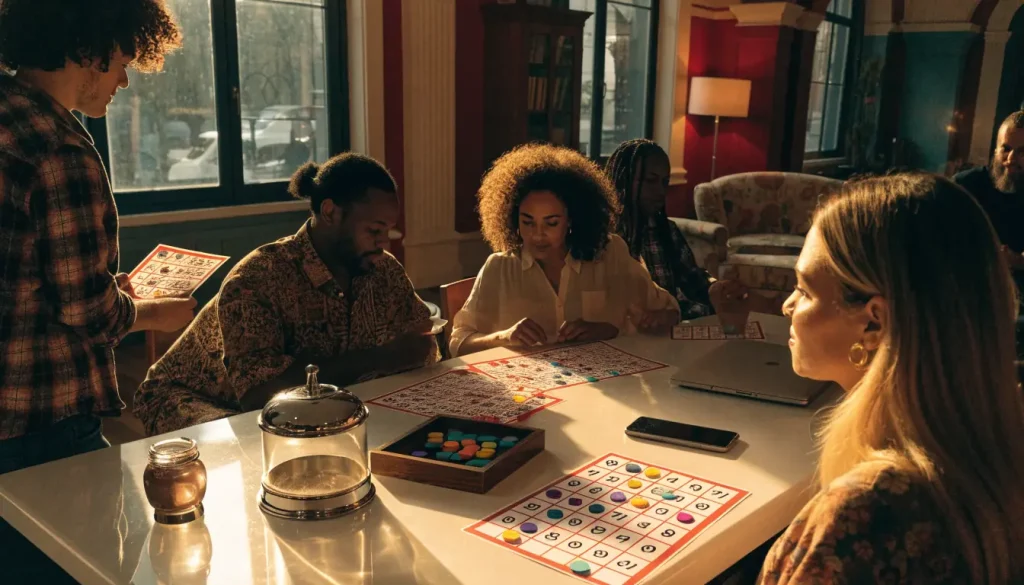
Bingo rooms run on tickets, shared draws and completed patterns, while slots remain separate games even when offered on the same site.
Table of Contents
- Bingo Rooms, Casinos and the Shared Game
- When Bingo Shares a Screen with Slots
- Bingo Sites with Slots: What the Room Offers
- Real-Money Bingo: Ticket Prices and Prizes
- Free Bingo Tickets and Slot Spins: The Conditions
- The Bingo Formats Behind Online Play
- Where Online Bingo and Slots Can Be Played
- Mobile Play and the Limits That Travel with It
- The Bingo Slot Machine Is Not a Bingo Room
- Can a Bingo Site Also Offer Slot Games?
Bingo Rooms, Casinos and the Shared Game
Online bingo can sit inside a casino site without becoming a casino game in the same sense as everything else in its catalogue. The site is a shared address; the games retain their own rules. Bingo begins with a ticket, proceeds through a draw and ends when a player completes the required pattern before others do. Its central event is not a choice made at each turn, but a sequence of numbers arriving and being matched against a card.
That distinction matters because a casino is often presented as one broad destination, while its contents ask for quite different kinds of attention. A bingo room organises play around a common draw. Each player’s ticket is a record of possible matches; the numbers called determine how that record changes. The game’s pace belongs to the draw, and the result depends on whether a pattern is completed in time. A casino site may place bingo beside other kinds of gambling, but the shared menu does not make their mechanics interchangeable.
Choosing an online bingo site involves more than finding games that suit you; practical details such as payout timing can also help inform your decision. Use this reference to review the payout information available for each operator.
1. Chanze
Payout speed: 1-3 business days Chanze lists a payout speed of 1–3 business days.
2. x3bet
Payout speed: 1-3 business days x3bet lists a payout speed of 1–3 business days.
3. Jetsetspins
Payout speed: 1-3 business days Jetsetspins lists a payout speed of 1–3 business days.
4. EvoSpin
Payout speed: 1-3 business days EvoSpin lists a payout speed of 1–3 business days.
5. SlotoSport
Payout speed: 1-3 business days SlotoSport lists a payout speed of 1–3 business days.
6. SpinFormula
Payout speed: 1-3 business days SpinFormula lists a payout speed of 1–3 business days.
7. BeOnBet
Payout speed: 1-3 business days BeOnBet lists a payout speed of 1–3 business days.
8. NightWin
Payout speed: 1-3 business days NightWin lists a payout speed of 1–3 business days.
9. NightLuck
Payout speed: 1-3 business days NightLuck lists a payout speed of 1–3 business days.
10. Amunbet
Payout speed: 1-3 business days Amunbet lists a payout speed of 1–3 business days.
The ticket is the starting point. Buying one means entering a particular game with a set of numbers to follow. When the draw begins, numbers are called and matched against the ticket. A player watches for the pattern that matters in that game, rather than simply waiting for a single winning number. The tension gathers gradually: a ticket may move from scattered matches towards a line or another required shape, while the remaining calls decide whether it can be completed before a rival’s.
Bingo has always made a small public event out of private chance. A player holds an individual ticket, yet the draw is shared. Everyone in the game follows the same sequence, and the order of calls becomes common knowledge. Online play preserves that structure even when the room is displayed on a screen. The important relationship is still between the ticket, the drawn numbers and the pattern being sought. The screen changes the setting; it does not alter the basic bargain.
This shared rhythm is one reason bingo can feel different from other casino entertainment. The participant is not merely observing a result produced elsewhere: each call is checked against a ticket, and the possibility of a win develops in visible stages. Nor is the game simply a private puzzle, since other players are pursuing patterns in the same draw. A completed pattern matters in relation to the room’s game, not as an abstract achievement on a card. The other tickets are part of the occasion.
The word “casino” can therefore describe the wider platform without describing the experience of every game within it. Online casino bingo is still bingo: its identity rests on tickets and a draw, not on the fact that it shares a digital home with other gambling products. This is a useful distinction when a site’s navigation groups unlike activities together. A common account or lobby may make the catalogue feel unified, but the player’s task changes from game to game. In bingo, attention follows the numbers and the pattern.
American Roulette at UK Online Casinos: 0 and 00
The pattern gives the draw its shape. Without one, numbers would arrive as a sequence with no meaningful finish. With one, each call has a consequence for every ticket: it may add a match, bring a player closer to completion, or leave the ticket unchanged. The rule turns chance into a recognisable contest. The card is not just a display of numbers; it is the surface on which progress can be read.
There is also a modest social logic in the arrangement. The room gathers people around a shared event while giving each person a separate ticket and a separate chance of completing the pattern. That combination—common sequence, individual outcome—has proved durable because it is easy to understand without making the game solitary. Online, the room can be entered through a casino site, but its defining unit remains the game of bingo itself.
For anyone trying to understand the relationship between casino and bingo, the clearest answer is not that one absorbs the other. A casino site may provide the setting; bingo supplies a distinct form of play. The ticket is bought, the numbers are drawn, and a win depends on completing the pattern ahead of other players. Everything else is scenery.
When Bingo Shares a Screen with Slots
A bingo room and a slot lobby can sit within the same online account, but proximity is not sameness. The room centres on tickets, a shared draw and a pattern that players are waiting to complete. A slot is a separate game, with its own result and rules. Putting both on one screen makes moving between them easy; it does not make their chances, pace or returns equivalent.
That distinction matters because a combined offer can blur the boundary. A bingo ticket may be presented alongside access to slot games, or a promotion may connect a ticket purchase with a spin. A specialist review has reported rooms making a free slot spin available with each bingo ticket bought. That is an offer described in a particular review, not a feature to assume across bingo rooms. The spin belongs to the promotional side of the arrangement; it does not alter the bingo draw or improve the ticket’s place in it.
Online Casino Without ID in the UK: What to Expect
The word “free” can make the two games seem joined at the point of play. In practice, the ticket still enters the bingo game, while the spin produces a separate slot result. One may bring a prize and the other may not. A winning line in the room is not a slot win, and a successful spin does not complete a bingo pattern. They are neighbouring events, not two stages of one game.
This is a small but useful distinction in the design of online bingo and slots. A site can group the games under one roof, display them in the same lobby and advertise a link between them, while each game retains its own rules and outcome. The shared account is an administrative convenience. It is not evidence that the games share a prize pool or a common calculation of returns.
Returns are another point where the categories should stay separate. The return-to-player figure for a slot describes that game’s theoretical payout over play; it should not be treated as a forecast of what an individual session will return. Bingo has a different structure, shaped by the room’s game and its prize arrangements. Side games can have a lower return-to-player percentage than the bingo room, so a slot placed beside bingo should not be presumed to offer the same return as the main game. The screen may be continuous. The arithmetic is not.
There is a cultural difference in the rhythm, too. Bingo makes its central event public: numbers are called, tickets are watched, and the result unfolds in company, even when the company is represented by names in a chat window. A slot compresses its result into its own repeated sequence. The first borrows some of its tension from waiting alongside other players; the second is organised around the individual game cycle. Both can be solitary in practice, but they make different use of attention.
A ticket-linked spin can therefore act as a bridge between two habits of play. It offers a reason to leave the room briefly, or to try a separate game without treating it as part of the draw. That bridge may be modest, but it is also a piece of commercial architecture: the bingo ticket introduces a slot, and the slot gives the site another way to hold attention. Nothing mysterious there. Just a different door.
Attention: A slot placed beside bingo should not be presumed to offer the same return as the main game, as side games can have a lower return-to-player percentage.
For players, the practical question is not whether bingo and slots appear together, but what exactly each part of an offer does. A free spin is not an extra bingo ticket unless the terms say it is; a ticket is not a stake in a slot; and a prize shown in one game does not describe the prospects of the other. Promotions can make the association look seamless, while the games remain distinct underneath.
This is why “bingo and slots” describes a catalogue more reliably than a single kind of play. The room’s social draw and the slot’s separate result can share a site without sharing their mechanics or returns. Treating the slot as a side game is reasonable; treating it as a continuation of the bingo game is not.
Bingo Sites with Slots: What the Room Offers
A site that brings bingo and slots together is arranging two different kinds of leisure under one roof. The bingo room is organised around a shared event: people enter the same game, and its appeal comes partly from being there with other players as the draw unfolds. Slots sit alongside it as separate games, available from the same broader catalogue but not governed by the room’s communal rhythm.
That distinction matters more than the size of the menu. A large slot selection does not tell much about what a bingo room feels like, and the presence of a busy room says little about the range of slots elsewhere on the site. The two may share a website, but a bingo ticket belongs to a particular game; choosing a slot is a separate act. The site’s design can make the boundary easy to see, or blur it with prominent offers and links. Either way, the games themselves remain different.
Online Casino Tournaments UK: Free Entry Explained
On a well-organised site, the room should be recognisable as a destination rather than just another tile in a games lobby. Its schedule, game names and prize information help establish what is happening and when. Slots, by contrast, are generally presented as individual titles or categories. That arrangement reflects two kinds of attention: one is directed towards a common event, the other towards a game selected by the individual.
The social element is not decorative. Bingo has long depended on a sense of occasion, whether gathered around a hall caller or following a digital draw from home. Online rooms preserve that collective frame, even where the surrounding site contains solitary games. A slot catalogue may add variety to the same account, but it cannot turn a slot session into a bingo room. Different machinery, different company.
A specialist review reports that bingo rooms’ busiest period falls between 7pm and 11pm, when operators schedule their largest prize pools. That observation should be read as a reported pattern, not a promise that every room will be busiest or most rewarding at those hours. A scheduled prize pool is part of a room’s calendar; it does not establish what an individual player will win. The timetable may help explain why a room attracts a crowd, but crowd size and a player’s result are not the same thing.
Specialist reviews report that bingo rooms’ busiest period often falls between 7pm and 11pm, when operators typically schedule their largest prize pools.
This also complicates the search for the “best” bingo sites with slots. There is no single measure that settles the question. Someone interested in the room may care about how clearly games and schedules are presented; someone drawn by slots may be looking at a different part of the catalogue. Treating the combined offer as one score can conceal the thing being assessed. A site can be expansive in one area and spare in another.
The same caution applies to newer sites. A recent launch, by itself, says nothing about the quality of its bingo rooms or the depth of its slot catalogue. Nor does a polished mobile layout settle the question: a small screen may display both kinds of game, but it does not make them interchangeable. The useful distinction is whether the room remains legible as a shared event, with its own information and timetable, rather than being reduced to a route towards other games.
For anyone comparing UK bingo sites with slots, the room and the catalogue therefore need to be considered separately. The surrounding site may join them in one place, but the room has its own character and schedule. A busy lobby is not the same as a lively room; a long catalogue is not the same as a good fit. The architecture is the offer. The games still have to speak for themselves.
European Roulette Online Casinos in the UK
Real-Money Bingo: Ticket Prices and Prizes
The price of an online bingo ticket can be small enough to look incidental or high enough to make the game feel like a deliberate spend. Low-stakes rooms are described with tickets from 1p to 5p, while premium games may charge £1 or more. Another description of the market places penny-room tickets at 2p and high-stakes games at £5 or more. The ranges do not form a single tariff: room categories and the games on offer differ.
Price matters because a bingo prize is connected to the game being played, not simply to the fact that a ticket has been bought. A lower-priced game may carry a modest prize; a higher-priced one may advertise a much larger potential return. That relationship is not a promise that a more expensive ticket will win, nor a reliable measure of value. The cost is certain. The result is not.
A specialist review gives one illustration of the contrast: a 1p game might have a £10 full-house prize, while a £1 game could carry a jackpot in the hundreds or thousands. Those figures describe an example, not a standing market rule. Prize pools change with the particular game and its terms, so one price point cannot be treated as a dependable guide to what another room will pay.
The difference between ticket cost and prize scale is worth keeping in view. A small stake can still be attached to a prize that feels meaningful, while a larger ticket does not turn a possible win into an expected one. Nor does a headline jackpot describe every prize available in a game. It is the advertised upper possibility, not a summary of the likely outcome for each participant.
Do
- Compare the prize schedule with the ticket price
- View prize banners as game descriptions
Don’t
- Assume a bigger prize means a better game
- Treat a headline jackpot as a likely outcome
For anyone comparing real-money bingo rooms, the ticket price is therefore only one part of the comparison. The prize schedule shows what a game pays for its stated outcomes; the ticket price shows what entry costs. Both belong together. A large prize can attract attention, but the number alone says little about the chance of claiming it or the total cost of taking part. There is no sensible shortcut from “bigger prize” to “better game”.
This distinction also keeps bingo separate from the broader catalogue of an online bingo casino. A site may present bingo alongside slots, but a slot’s stake and potential return are not the same thing as a bingo ticket price and room prize. The comparison here concerns the bingo game itself: what a ticket costs and what the room lists as its prizes. Side offers, promotional play and slot returns have their own terms and do not change the underlying price of a bingo ticket.
The restrained way to read a prize banner is to treat it as a description of the game, not an estimate of personal return. Ticket prices may start in pennies and rise into pounds; prizes can vary just as sharply. The higher figure is more conspicuous. It is not more certain.
Free Bingo Tickets and Slot Spins: The Conditions
A free bingo ticket has a price of zero, but that does not make its conditions disappear. Promotional play is often confined to a particular room or ball type, so a ticket may be valid for one game and unusable in another. The offer’s wording matters: a ticket described as free does not necessarily mean unrestricted access to every bingo room.
Online Casino Games for Real Cash in the UK
Expiry is another boundary. A specialist review describes free tickets that expire after 24 hours; that is an example of a specific offer, not a timetable that applies across the market. Once a ticket has expired, its promotional value is gone. The same principle applies to a free slot spin attached to an offer: the promotion’s terms determine where it can be used and how long it remains available. A spin is not a cash balance, and its presence does not turn a bingo ticket into a slot-game credit.
The distinction becomes more consequential when a free ticket wins. The ticket itself cannot be withdrawn as money. Instead, any winnings are credited as cash, and those winnings may still be subject to a wagering requirement, including the requirement attached to a deposit bonus. In other words, a win can appear in the account without being immediately available for withdrawal.
A specialist review gives a range of 20x to 65x for wagering requirements on free-ticket winnings. That range describes the offers covered by that review; it should not be read as a fixed rule for every operator. The terms of the particular promotion determine what counts towards the requirement. If the winnings are tied to a deposit bonus, the deposit bonus conditions may also matter. The small print is doing real work.
This is why promotional value cannot be judged by the number of tickets or spins alone. A ticket restricted to a certain room, or to a specific ball type, may be less useful to someone who intends to play elsewhere. A prize credited as cash may still be locked behind a wagering requirement. And a short expiry can leave little time to use the offer at all.
Attention: Winnings from free tickets may be subject to wagering requirements, meaning they might not be immediately available for withdrawal.
Free online bingo and slot promotions are therefore best understood as conditional credits rather than cash gifts. The ticket may open a game, and a win may create a balance, but neither step guarantees that the money can be withdrawn straight away. Terms vary from offer to offer; the relevant conditions are those attached to the promotion itself.
The Bingo Formats Behind Online Play
The format of an online bingo game is visible before the draw begins: in the shape of the ticket and in the pattern that counts as a win. Numbers may be called in every version, but the route across the card changes. A familiar word, “bingo”, covers several different arrangements.
In 90-ball bingo, the ticket is a rectangle of nine columns and three rows. The winning sequence is cumulative: a prize can go to the player who completes one line, then to the player completing two, and finally to the full house. The appeal lies partly in that progression. A ticket can remain in contention after the first line has been claimed; the game does not become a single race with one finish.
The format also makes the card easy to read at a glance. Rows provide the visible targets, while the full house gives the draw a final point of resolution. That structure has helped make 90-ball bingo a recognisable form in the UK, with its own pace and expectations. Not merely a grid.
80-ball bingo changes the geometry. Its ticket is arranged as an eight-column by four-row grid, and the winning target may be a coloured pattern rather than a completed line. Four corners, a letter shape or the whole card can define the task. The pattern is the rule: a player is not simply waiting for a row to fill, but watching the called numbers build a particular outline.
Live Casino Lightning Roulette in the UK: How It Works
That difference changes how the ticket is read. A shape may be scattered across the grid, so attention moves between positions instead of following one horizontal track. Colour helps mark the target, turning the card into something closer to a small diagram than a set of lines. The winning condition is still fixed, but its visual language varies from game to game.
75-ball bingo uses a five-by-five grid. Here, patterns can include a cross, an X, a diamond, the letter T or a picture frame. The range gives each game a distinct silhouette: the same grid can ask for a different arrangement, and the draw becomes a process of completing that design.
For anyone comparing online bingo games in the UK, the useful distinction is not a promise of better odds or larger prizes; it is the ticket’s geometry and the pattern the game recognises. A line-based target is legible in one way, a coloured shape in another. The rules are printed in the card itself.
Where Online Bingo and Slots Can Be Played
Online bingo and slots may sit under the same roof, but the legal boundary is set by the operator’s authority to serve people in the United Kingdom, not by the appearance of its games. Online bingo is legal in the UK, within a heavily regulated system. A business offering real-money gambling to UK customers must hold the relevant operating licence from the UK Gambling Commission (UKGC), wherever that business is based.
Legal Requirement
Any business offering real-money gambling to UK customers must hold a valid operating licence from the UK Gambling Commission (UKGC).
That requirement matters because a familiar name, polished website or British-themed room is not proof of permission. A site operating from overseas is not exempt from the rules simply because its servers or company address are elsewhere. Remote operators selling into the British market must hold a UKGC licence. A licence from another jurisdiction does not replace it.
The licence carries standards that reach beyond whether a game appears to work as advertised. The UKGC requires operators to address fairness, anti-money laundering and responsible gambling. These obligations place the service within a system of oversight; they are not decorative assurances attached to a logo. Gambling law, after all, is also a statement about what a state expects businesses to prevent, not merely what customers may choose to play.
There are practical signs to check before an account is funded. The operator should prominently display its UKGC licence number in the footer. That number can be checked against the Commission’s public register. If the number is absent, the sensible response is to close the tab, not to treat the omission as a minor design choice.
Legal access also has an age boundary: online gambling is for people aged 18 and over, and licensed operators must verify a customer’s age before allowing a deposit. Identity checks are part of the regulated account relationship, rather than an optional extra that appears only when a withdrawal is requested.
Mines Casino Game in the UK: What Can Be Known
The distinction is straightforward, even if the internet makes geography look conveniently vague: bingo and slots can be offered online to UK players by operators holding the proper UKGC licence. The licence governs the service, while the games remain different products with their own rules. Oversight first; entertainment second.
Mobile Play and the Limits That Travel with It
A phone changes the size of the screen, not the nature of the account. Bingo and slot games may sit side by side on a mobile site, but the controls that matter for spending are account-level safeguards, rather than rules belonging to one particular game. Their value lies partly in that reach: a limit can put a boundary around spending across different kinds of play.
UK remote operators must prompt new customers to set a financial limit before their first deposit and make account-level limit controls accessible. A specialist review reports that operators may offer deposit limits set by day, week or month; the available settings can vary, so the account’s own terms determine what can be selected. The practical point is to choose a ceiling before play begins, rather than treating a limit as a response to money already spent. A small interruption can matter.
Mobile access makes gambling available in more places, but it does not make the account private from its own history. Deposits accumulate across sessions, and switching from bingo to slots does not erase the sum already committed. A limit can help keep that total visible and bounded. It is not a prediction of winnings, nor a way to make gambling risk-free; it is a restriction on how much can be deposited within the period selected.
Account Safeguards
- Set a financial deposit limit (daily, weekly, or monthly)
- Complete identity verification with photo ID
- Provide proof of address for account validation
- Review available responsible gambling tools
The same account also carries identity and age checks. Operators must verify age before accepting a deposit, and UKGC licensees must verify customers’ identities. That process commonly involves photo identification and proof of address. These are not mobile-only hurdles: a smaller screen does not create a separate standard.
Other protections are attached to the operator’s obligations, not to the device. UKGC-licensed casinos must provide responsible gambling tools, including self-exclusion. The controls remain part of the account whether play takes place on a phone or elsewhere. The screen travels; the safeguards should, too.
The Bingo Slot Machine Is Not a Bingo Room
A bingo-themed slot borrows the look of bingo without becoming a bingo game. Its symbols may recall numbered balls, cards or a hall, but the theme does not give the player a ticket in a shared draw. Nor does it inherit bingo’s pattern-based route to a prize. The resemblance is decorative; the game mechanics belong to slots.
In a bingo room, players hold tickets while numbers are called, and a winning pattern decides the result. A slot instead runs through its own spin-based rules. That difference matters more than the artwork: the two games do not share a draw, a ticket structure or a common prize pool. A familiar image can disguise a different bargain.
The pace of bingo itself varies by format. The 80-ball version uses a compact four-by-four card and reaches its result more quickly than 90-ball play. That shorter rhythm still belongs to bingo: numbers are drawn against cards, rather than symbols being spun as a slot outcome. Speed alone does not make it a slot.
The phrase “bingo slot machine online” can therefore point to two rather different things: a slot with bingo imagery, or a search for bingo games available online. The distinction is not pedantic. Someone expecting a room, a draw and a pattern may find that a themed slot offers none of them. Conversely, a 90-ball room is not a slot merely because it appears on the same gambling site.
Plinko Casinos in the UK: Licensing, Play and Payments
Names and illustrations are cheap ways to suggest company between games. Rules are less easily borrowed. A bingo theme is not a bingo room.
Can a Bingo Site Also Offer Slot Games?
Yes. A site can place bingo rooms and slot games in the same catalogue, so the same account may provide access to both. That shared address does not make the games one product. A bingo ticket enters a draw, and its result depends on numbers being called and a pattern being completed. A slot spin is a separate game with its own rules and outcome.
The distinction matters when a promotion links the two. A specialist review has reported rooms offering a free slot spin with each bingo ticket bought. That is a particular offer, not a feature to assume across bingo sites. The spin belongs to the slot game; it does not add numbers to a ticket or alter the bingo draw. Any attached conditions sit alongside, rather than inside, the bingo rules.
The returns also need to be considered separately. Side games can have lower return-to-player percentages than the bingo room itself, so a shared lobby says little about how either game is structured. A common menu is not a common set of odds.
Britain places specific controls on online slot play. Autoplay is banned, and each spin must last at least two and a half seconds. The rules apply to the slot game even when it appears beside bingo, rather than on a site devoted to slots. The interface may make changing between the two feel seamless; the underlying games remain distinct.
This separation is useful when reading a site’s catalogue or an offer. A bingo ticket buys entry to a particular draw, while a slot promotion concerns a different game and may carry its own terms. The room and the reel share a screen, not a rulebook.
What is a wagering requirement?
A wagering requirement is the amount you must spend on eligible bingo tickets before bonus funds or winnings can be withdrawn. For example, a £40 bonus with a 4x requirement means £160 in eligible ticket spending.
Can I play bingo without buying a ticket?
Yes, some offers include free bingo tickets, but they may be limited to certain rooms or ball types and expire after 24 to 72 hours. Winnings from free tickets may also have wagering requirements before withdrawal.
Are online bingo winnings taxable in the UK?
No, online bingo winnings are not taxable for recreational players in the UK.
How do I know if an online bingo site is safe?
Check that the operator holds a UK Gambling Commission licence to offer services to UK players. Licence requirements cover standards including fairness, anti-money laundering and responsible gambling.
Casino Games
American Roulette at UK Online Casinos: 0 and 00
American roulette adds a double-zero pocket to the familiar wheel, affecting its layout, betting options...

Aviator Casino Game in the UK: Rules and Play
A clear look at UKGC licensing, offshore casinos, demo claims, bonuses and payment routes around...
Three-Reel Slots in UK Online Casinos
Explore the classic reel format, real-money and free-play settings, variance, and the UK rules governing...

5-Reel Slots in the UK: Demos, Stakes and Play
Five reels define the format, while demo play, bonus features and the casino setting shape...

Bonus buy slots in the UK: trying demo play
Practice modes can show how a bonus-buy feature works, but availability varies by game and...

UK Online Casino Fast Payouts: Keno Returns Explained
A keno paytable shows possible game winnings, while an account withdrawal follows a separate operator...

UK First-Deposit Casino Bonuses: How Offers Work
A first-deposit label describes when an offer applies, while eligibility, rewards and withdrawal rules depend...

High-Volatility Slots in the UK: How They Work
Volatility describes the general frequency and scale of slot wins, not a guarantee or timetable...

Keno at UK Online Casinos: Odds and How to Play
Keno outcomes depend on the numbers selected before a random draw, while paytables determine how...
Live Casino UK: How Online Tables Work
A live casino pairs a physical table broadcast with on-screen controls, while the lobby brings...

Low-Volatility Slots in the UK: How They Work
These games tend to distribute returns as more frequent, smaller wins, but volatility cannot predict...

Online Slot Payout Percentage: What RTP Means
A payout percentage describes a theoretical return across repeated play, not the result of any...
Best RTP Casino Slots in the UK: How Returns Work
An advertised return is a long-run calculation, not a prediction of session results; volatility helps...

Video Slots UK: Reels, Bonuses and How Play Works
A clear guide to reel patterns, bonus features, casino play and the differences between free...

Casino Dice Games in the UK: Odds, Sites and Stakes
A clear look at how casino dice wagers work, what chance can reveal, and where...
Chicken Road Game Casino UK: What the Label Means
The Chicken Road label alone does not confirm a game’s format, availability, rewards or casino...

Crash Casino Games in the UK: How They Work
Crash games turn an uncertain wager into a rising visual, while licensing, payments and promotional...
Crazy Time Live Casino Game in the UK
A guide to the studio stream and betting interface, with context on UK casino choices,...

Deal or No Deal Casino UK: How the Game Works
The format turns hidden briefcase values and a cash offer into a decision about whether...

European Roulette Online Casinos in the UK
A practical guide to the single-zero wheel, betting choices, payouts and how European roulette differs...

Fastest Payout Online Casino UK: What Claims Mean
A fair comparison depends on verified casino-specific times, consistent conditions and a clear definition of...
French Roulette Online Casinos in the UK
French roulette pairs the familiar European wheel with rules that soften zero’s impact on even-money...

Hi-Lo Casino UK: How the Card Game Works
Hi-Lo rules vary by format, including how ties, matching values and successful predictions are treated....

High-RTP Slots in the UK: How RTP Really Works
RTP is a long-run feature of a slot’s mathematical design, not a prediction of what...

JetX Casino Game in the UK: What the Label Means
A careful look at JetX’s classification, demo claims, UK casino access and the limits of...

Live Baccarat Online Casinos in the UK: How It Works
A look at baccarat scoring, live-dealer play, UK licensing, stakes and the terms that can...

Live Blackjack Online Casinos in the UK: How It Works
A clear guide to the dealer, betting interface, table limits and rules behind live blackjack...
Live Casino Lightning Roulette in the UK: How It Works
A live dealer conducts the game in a studio, while the online interface handles bets...

Live Dream Catcher Casino UK: How the Game Works
A guide to the live dealer format, physical wheel, site considerations, and what demo play...

Live Roulette UK: English-Speaking Dealers
A look at the dealer, streamed wheel, betting interface and the limits of what live...

Mines Casino Game in the UK: What Can Be Known
An overview of Mines in the wider casino landscape, including demo play, prediction limits and...

Monopoly Live Casino UK: How Live Play Works
A practical look at the studio, on-screen controls and the limits of treating a live...

Online Casino Games for Real Cash in the UK
A practical look at spin costs, withdrawable wins, bonus conditions and the limits of judging...

Online Casino Tournaments UK: Free Entry Explained
Tournament terms shape whether entry is free, which spins count, and how scores relate to...
Online Casino Without ID in the UK: What to Expect
A sign-up without document uploads does not mean anonymous play; UKGC-licensed casinos must verify players,...

Plinko Casinos in the UK: Licensing, Play and Payments
Plinko’s legal context, demo limits, casino terms and payment options depend in part on whether...





























































































































































































































































