
£1 Minimum Deposit Casinos in the UK: What It Means
 Available in GB
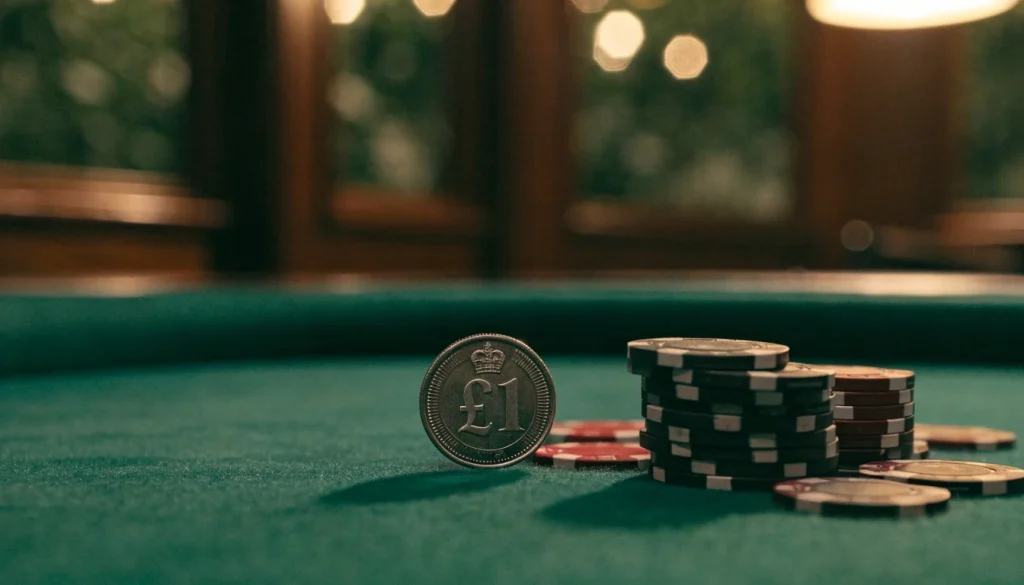
A low cashier threshold is only an entry point; the balance, eligible offers and payment terms determine what follows.
Table of Contents
- What a £1 Minimum Deposit Actually Buys
- Finding a Low Entry Point Without Mistaking It for a Deal
- The Online Casino Cashier and Its Small Print
- Real-Money Play on a Phone: The Arithmetic After Deposit
- Bonuses, Free Spins and the £1 That May Not Count
- Slots on a £1 Balance: Small Stakes, Short Runway
- PayPal and the Payment-Method Catch
- New £1 Casinos: What the 2026 Evidence Actually Shows
- SMS Deposits and the Narrowest Route In
What a £1 Minimum Deposit Actually Buys
A £1 minimum deposit is a real threshold, not a promotional way of describing a larger payment. Some casinos serving the UK market accept that amount as the minimum needed to put money into an account. Once the payment is accepted, the pound becomes deposited cash in that account. It does not, by itself, become a welcome bonus or a promise of extra funds.
That distinction sounds almost too plain to need stating. Yet casino language often puts several different things close together: the amount needed to open an account, the amount needed to qualify for an offer, and the amount available to wager. They are not interchangeable. A cashier minimum describes the first of these. It tells how little may be deposited under the relevant conditions; it says nothing about whether a promotion is attached or how long the resulting balance might last.
The £1 figure is therefore best understood as an entry threshold. It is not a measure of the cost of playing, and it is not a forecast of what a session will involve. A person can deposit £1 and then find that the games available to them require stakes that make the balance brief. The account has accepted a small payment; the games have not thereby become cheaper. A low doorway is still only a doorway.
A low minimum deposit can make it easier to start with a small budget, but check each casino’s current deposit terms before signing up. The details below provide one practical point of reference: stated payout speed.
1. Chanze
Payout speed: 1-3 business days Chanze lists a payout speed of 1–3 business days. This is the available point of reference when considering it for a low-deposit search.
2. x3bet
Payout speed: 1-3 business days x3bet lists a payout speed of 1–3 business days. This is the available point of reference when considering it for a low-deposit search.
3. Jetsetspins
Payout speed: 1-3 business days Jetsetspins lists a payout speed of 1–3 business days. This is the available point of reference when considering it for a low-deposit search.
4. EvoSpin
Payout speed: 1-3 business days EvoSpin lists a payout speed of 1–3 business days. This is the available point of reference when considering it for a low-deposit search.
5. SlotoSport
Payout speed: 1-3 business days SlotoSport lists a payout speed of 1–3 business days. This is the available point of reference when considering it for a low-deposit search.
6. SpinFormula
Payout speed: 1-3 business days SpinFormula lists a payout speed of 1–3 business days. This is the available point of reference when considering it for a low-deposit search.
7. BeOnBet
Payout speed: 1-3 business days BeOnBet lists a payout speed of 1–3 business days. This is the available point of reference when considering it for a low-deposit search.
8. NightWin
Payout speed: 1-3 business days NightWin lists a payout speed of 1–3 business days. This is the available point of reference when considering it for a low-deposit search.
9. NightLuck
Payout speed: 1-3 business days NightLuck lists a payout speed of 1–3 business days. This is the available point of reference when considering it for a low-deposit search.
10. Amunbet
Payout speed: 1-3 business days Amunbet lists a payout speed of 1–3 business days. This is the available point of reference when considering it for a low-deposit search.
There is a useful social history in the small-print distinction. The cashier presents money as a simple transfer: funds go in, and a balance appears. Promotions, by contrast, are conditional arrangements. They may require a qualifying deposit, and the terms decide whether a payment counts. The convenience of seeing one figure near another can make them seem like a single bargain. They are separate decisions made by the operator, and the deposit amount alone does not settle either one.
For a UK customer, the setting matters as much as the arithmetic. Real-money casino operators serving Great Britain must hold the relevant Gambling Commission licence, and online gambling is legal in the UK at licensed and regulated sites for adults aged 18 and over. Before a first deposit, a remote operator must prompt a new customer to set a financial limit and make account-level controls available. Age must also be verified before deposits are allowed. These requirements make the £1 threshold part of a regulated account relationship, not a loophole around the ordinary rules.
The payment itself must come from a permitted source. UK-licensed casinos cannot accept credit cards for gambling. Compliant routes include debit cards, e-wallets funded by debit, and bank accounts. The smallness of a payment does not change that boundary. A pound sent through an impermissible source would not become acceptable because the amount is modest; regulation is not a sliding scale.
£2 Minimum Deposit Casinos in the UK: What It Means
A specialist review reported six UKGC-licensed casinos as accepting a genuine £1 minimum deposit, but that is a snapshot of the operators checked rather than a permanent census of the market. Within that review’s list, NetBet was the sole UKGC-listed casino shown with a £1 cashier minimum. The wording matters: it describes what that particular review found, not a guarantee that the same threshold will remain available or apply to every account and payment route. A minimum can be a practical setting, not a national characteristic.
The word “genuine” also does quiet work. It separates an actual cashier minimum from an offer that merely advertises a small starting amount while attaching a different qualifying condition elsewhere. If a casino accepts £1 as a deposit, that establishes only that the deposit can be made at that level. It does not establish eligibility for every promotion, prove that every payment route accepts the same amount, or set the minimum required to withdraw. Those are distinct terms.
In ordinary household accounting, a pound is a small sum; in a casino account, it is simply a balance subject to the operator’s rules and the games’ prices. The threshold may appeal to someone who wants to see how an account works without committing more money at the outset. But the amount deposited remains money at risk once it is used for gambling. Its modest size changes the scale, not the nature, of the decision.
Attention: A £1 deposit is an entry threshold, not a guarantee of eligibility for promotions or a forecast of how long a session will last.
So the promise contained in a £1 minimum deposit is narrow but real: an eligible customer may be able to fund an account with one pound. Nothing more should be smuggled into that sentence. Not free money. Not a bargain on every game. Not a guarantee that the amount will unlock an offer or return as a withdrawable balance. Just a low entry point, with the rest governed by separate terms.
Finding a Low Entry Point Without Mistaking It for a Deal
A £1 minimum deposit is a real threshold at some UK casinos, but it is not the same thing as a casino being inexpensive in every respect. The cashier may accept a pound while the wider account rules make that amount less useful than it first appears. A low entry point describes one part of the arrangement, not its overall value.
The comparison matters because the more familiar figure is higher. A specialist review of UK casinos accepting direct banking placed the typical minimum at £10, with some operators asking for £5 and others £20. That is a reported market snapshot, not a permanent tariff: operators can change their terms, and a figure attached to one payment route should not automatically be treated as the rule for every route or account.
Against that background, £5 is cheaper than the cited typical figure, but it is not the lowest available threshold. £1 is the genuine low-entry end of the scale. The distinction is small on the page and substantial in practice. A casino with a £5 cashier minimum may be more accessible than one requiring £10 or £20, yet it is still not a £1 minimum deposit casino.
£3 Minimum Deposit Casinos in the UK: What to Know
That difference can get blurred by loose descriptions such as “low deposit”. The phrase may cover several tiers, from a modest reduction on the common figure to the actual £1 threshold. For anyone comparing minimum-deposit casinos, the exact amount matters more than the label. A site is not a £1 option simply because its minimum is lower than a competitor’s.
Nor does the smallest threshold establish which casino is best. It answers a narrow question: how little can be deposited under the stated terms? A broader judgement would have to account for the operator’s licence and account rules as well. In Great Britain, an operator offering real-money online gambling must hold the relevant UK Gambling Commission licence. A low figure on a page is not a substitute for that regulatory status.
This is one of those places where “legit” and “cheap” are not synonyms. A genuine £1 minimum can be relevant to affordability, but it does not certify an operator or make every part of the offer favourable. A casino’s minimum deposit is only one line in its terms. The number is clear. Its significance is not.
A review of the market also reported that many casinos do not count a £1 deposit towards a welcome offer, restrict some payment methods at that level, or set a withdrawal threshold above £1. Those are findings attributed to a specialist review, rather than universal conditions that can be assumed of every operator. Their practical point is still important: the lowest amount accepted at deposit does not necessarily define the lowest amount that qualifies for other account functions.
Do
- Check if the operator holds a UK Gambling Commission licence
- Verify if the £1 minimum applies to your specific payment route
- Review the withdrawal threshold in the account terms
Don’t
- Mistake a low deposit threshold for an overall “cheap” casino
- Assume a £1 deposit automatically qualifies for a welcome offer
- Confuse a “low deposit” label with a guaranteed £1 minimum
That makes “cheaper than average” a poor shortcut for judging whether a £1 casino is a useful choice. The comparison should keep separate three questions: whether the operator accepts a pound, whether the chosen route permits that amount, and whether the deposit has the same standing as a larger one under the account terms. The first is the headline threshold. The others determine how far the headline travels.
The same care applies to claims about a new £1 casino. “New” describes an operator’s arrival or a recent change; it does not tell anything by itself about the cashier minimum, the licence, or the conditions attached to the account. A fresh name can still have an ordinary minimum, while an established operator may have a low one. The useful evidence is the current term, not the adjective.
There is a social history in these small numbers. Gambling accounts have long been framed around a first payment: a point at which a prospective customer crosses from looking to playing. A low threshold makes that crossing appear slight. The amount can be genuinely small, but the design of the offer may still encourage the idea that entry and value are the same thing. They are not.
The UK’s licensing framework gives the comparison a necessary boundary. Online gambling is legal for adults at sites licensed by the UK Gambling Commission; operators serving Great Britain must hold the relevant licence. That does not make every licensed casino identical, nor does it turn the minimum deposit into a recommendation. It establishes who may lawfully offer the service, while the deposit terms remain a separate matter.
£4 Minimum Deposit Casinos in the UK: Key Terms
A sensible comparison therefore avoids both exaggerations: a £1 minimum is not meaningless, and it is not proof of a bargain. It is a genuinely low entry point when the operator’s terms allow a deposit of that amount. Whether it is a better choice than a £5 or £10 minimum depends on the rest of the arrangement, not on the smallest number printed beside the cashier.
Small threshold. Bigger terms.
The Online Casino Cashier and Its Small Print
A cashier minimum is a threshold for adding money to an account, not a promise that every route into that account works on identical terms. At a UK casino, the minimum is generally shared across the payment methods shown in the cashier. Some operators, however, set a higher threshold for direct banking than for cards or e-wallets. The figure beside the deposit box therefore describes an operator’s rule, while the available routes may still matter.
That distinction is easy to miss because the cashier often presents a neat row of payment logos and a single amount field. The interface suggests a common doorway. Behind it, each method has its own processing arrangements, and an operator may apply a different minimum to a particular route. A £1 minimum deposit at an online casino is meaningful only when it applies to the method actually selected—not merely because £1 appears somewhere in the cashier.
UK-licensed casinos are prohibited from accepting credit cards for gambling; permitted sources include debit cards, bank accounts, and debit-funded e-wallets.
The amount entered is also separate from the minimum the operator permits. A cashier may state a floor, then reject a smaller entry or prevent the deposit from proceeding until the amount meets that floor. Where the minimum differs by route, changing the method can change what the cashier accepts. That is a matter of the operator’s setup, not evidence that a payment service independently guarantees a £1 transaction at every casino.
The payment menu must also be read within the rules that govern gambling in Britain. Remote operators serving Great Britain need the relevant UK Gambling Commission licence, and licensed casinos cannot accept credit cards for gambling. Permitted funding routes include debit cards, e-wallets funded by debit, and bank accounts. A familiar payment mark does not override those restrictions: the source of funds matters, not merely the name printed on a button.
There is an administrative threshold before the financial one. Operators must verify a customer’s age before allowing deposits, and new customers must be prompted to set a financial limit before making a first deposit. These are not decorative interruptions to the cashier flow. They are part of the conditions under which a lawful account can be funded. The screen may look like a small piece of commerce; the rules make it a controlled point of entry.
UK No-Minimum-Deposit Casinos: Payment Rules
A deposit confirmation answers a narrow question: whether money has been credited to the gambling account. It does not establish that the same amount can be withdrawn immediately, that every route offers the same withdrawal process, or that a displayed minimum covers the whole relationship between deposits and withdrawals. Deposit and withdrawal thresholds are separate terms. A specialist review cited for this topic reports withdrawal minimums of £10 to £20 at many UK casinos; that is a report from that type of source, not a universal cashier rule. The operator’s own terms determine the applicable threshold.
This difference matters particularly when the original deposit is small. A cashier minimum can govern what enters the account while the withdrawal policy governs what can leave it. The two figures may not match. Nor does a successful deposit confirm that a withdrawal request will be handled through the same payment route; the cashier’s displayed deposit options should not be read as a complete statement of payout arrangements.
The useful habit is to treat each line of the cashier as a separate condition: the minimum for the chosen deposit route, the permitted funding source, and the withdrawal terms elsewhere in the account rules. A single headline figure cannot carry all of that information. Where the cashier offers direct banking, its minimum may be higher than the one shown for a card or e-wallet; where it does not, the general operator minimum may apply across the available methods.
There is a certain bureaucratic neatness to a single number: it looks definitive, and the interface has no reason to volunteer the qualifications unless someone opens the terms. But a minimum is not a general measure of access, nor a guarantee about what follows once funds arrive. The cashier sets the entry condition for a particular transaction. The operator’s wider rules set the rest. Short version: the box is not the contract.
Funds deposited into a casino account are money at risk once used for gambling, regardless of the modest size of the deposit.
Real-Money Play on a Phone: The Arithmetic After Deposit
A £1 deposit can be enough to open a real-money balance on a mobile casino account. It does not, by itself, make that balance large enough to sustain much play or easy to withdraw. On a phone, the distinction can disappear behind a neat cashier confirmation: the money has arrived, but its practical reach is still small.
Many slots accept stakes of 10p to 20p per spin. At those prices, a £1 balance represents five to ten spins if every spin is played at the same stake and none of the balance changes. That is arithmetic, not a promise of a particular session. A win could extend the balance; losses could end the run sooner. The small deposit is a narrow runway, not a miniature version of a larger bankroll.
That scale matters on a mobile screen, where depositing can feel like a single tap and the account balance is immediately visible. The interface makes the money look ready for use. It cannot make a pound behave like more than a pound. A £1 minimum deposit casino in the UK may therefore be suitable for testing whether an account accepts a small payment, while offering little room for a sustained sequence of real-money play.
The exit can be just as important as the entry. A specialist payment-method review described minimum withdrawal amounts in the £1 to £5 range for some casinos and payment routes. A separate specialist casino review reported thresholds of £10 to £20 at many UK casinos. These are different reported ranges, not a single rule for every operator. The cashier’s withdrawal terms determine which applies.
Online Casinos With No Sister Sites in the UK
Where a threshold is higher than the balance, a player cannot simply request the remaining pound and close the loop. More play may be needed to reach the stated minimum, and that brings the possibility of losing the balance before a withdrawal can be requested. The fact that a casino accepted £1 at deposit does not establish that it will return £1 on demand.
The phone changes the setting, not the arithmetic. A mobile casino account uses the same real-money balance as its desktop counterpart; the screen is smaller, the access more immediate, and the stakes still come out of the same finite sum. A £1 balance can support a brief encounter with a game, but the number of spins is not a measure of value or entertainment. The run may be over quickly.
There is also a difference between what a payment route can process and what a casino will permit as its cashier minimum. Debit cards and some e-wallets support £1 transactions, but that does not mean every mobile casino accepts a pound through every route. The operator’s stated threshold and withdrawal rules shape the usable balance.
In Britain, age verification must take place before funds can be deposited, and new customers must be prompted to set a financial limit before their first deposit. These steps sit alongside the transaction, rather than changing its size. A small entry point remains a real-money decision, however modest the amount appears on screen.
Mobile Balance Arithmetic
A £1 balance on a mobile casino typically supports five to ten spins on slots with stakes of 10p to 20p, provided no wins occur to extend the session.
A pound goes in easily. Getting a meaningful stretch of play—or a withdrawable balance—out of it is another calculation.
Bonuses, Free Spins and the £1 That May Not Count
A casino’s cashier minimum and its welcome-offer threshold answer different questions. The first determines how little can be deposited; the second determines what deposit qualifies for a promotion. A £1 minimum deposit casino can therefore accept the money and still leave the welcome offer inactive. The balance is real. The bonus is not.
A specialist review describes welcome offers requiring a deposit of £5 to £10. That is a reported range, not a universal rule: some UK casinos also exclude their lowest deposit bracket from welcome promotions. The promotion’s terms decide whether a £1 payment qualifies, and the cashier accepting it does not settle the matter. A platform may permit a small cash deposit while reserving its advertised offer for a higher qualifying amount.
This distinction matters to searches for a casino with a £1 minimum deposit and a bonus. The deposit threshold alone cannot establish that the bonus is available at that level. Nor does a deposit-triggered offer amount to a no-deposit bonus: one requires qualifying funds to be paid in, while the other is not activated by a deposit. The label is not the terms.
Wagering rules have also changed. Since 19 January 2026, the UK Gambling Commission has capped wagering requirements on bonus funds at 10 times the bonus amount. An older-looking term should not be read as permission to impose a higher current requirement. The cap concerns the bonus funds; it does not make every other restriction disappear. Game eligibility and any withdrawal conditions still need to be read in the offer’s terms.
Free spins can create a separate calculation because the prize is the winnings from the spins, not simply the spins themselves. A specialist review has reported wagering terms of 30 to 65 times the total won from free spins. Those figures describe reported terms, not a lawful current allowance above the Commission’s cap: since the change in 2026, gambling incentives cannot require more than 10 times wagering of bonus funds. The wording attached to a particular offer should be checked against that rule before its winnings are treated as withdrawable.
The practical question is therefore not merely whether a site offers spins or accepts a pound. It is whether that deposit qualifies, what balance or winnings the promotion creates, and what conditions apply before those winnings can be withdrawn. A small qualifying deposit can still be a poor fit if the promotion’s terms are misunderstood. Free spins are not cash in hand.
Slots on a £1 Balance: Small Stakes, Short Runway
A £1 balance can reach the reels, but it does not stretch far. Many slots allow stakes of £0.10 to £0.20 per spin, so a pound represents five to ten spins at those levels if every stake is lost. That is a short session, not a dependable bankroll. A win may extend it; a run of losing spins may end it almost at once.
Since 19 January 2026, the UK Gambling Commission has capped wagering requirements on bonus funds at 10 times the bonus amount.
The arithmetic matters more than the label attached to a casino. A site may accept a £1 deposit and offer slots, yet the balance still has to meet the chosen game’s stake. The cashier threshold says nothing about how long play will last, and a small balance does not make each spin less consequential. The reel keeps its own accounts.
Free spins can complicate the picture. They may look like a way to keep playing without spending the deposited pound, but any winnings can come with conditions before they become withdrawable cash. A specialist casino review has described wagering requirements of 30x to 65x the winnings from free spins. That range should not be mistaken for a current allowance: since 19 January 2026, UK gambling incentives cannot require more than 10x wagering of bonus funds. The terms attached to a particular promotion still matter, including how it treats winnings and what counts towards wagering.
Time is another condition. A specialist casino review has recorded free-spin expiry periods from 24 hours to 14 days. A session can therefore be bounded both by the small balance and by a clock attached to the spins. Unused spins may lapse; winnings may remain subject to their own requirements. The apparent gift has paperwork.
For a £1 minimum deposit slots search, the useful distinction is between access to a game and a meaningful run of play. A low entry point can open the account, but the stake size determines how quickly the balance is exposed. Choosing a slot with a lower permitted stake may make the pound last longer in spin-count terms; it cannot remove the possibility of losing it. Nor does a free-spin label turn winnings into unrestricted funds.
In Britain, online slot autoplay is banned, and each spin must last at least 2.5 seconds. Those rules make play a sequence of deliberate actions rather than a continuous automatic run. They do not change the underlying arithmetic: at the stated stakes, the balance remains small. UK-licensed operators must also prompt new customers to set a financial limit before their first deposit, a useful counterweight to the ease of placing another stake.
A £1 slot balance is best understood as a brief test of a game, not as evidence that a session can be sustained. Small entry. Smaller runway.
PayPal and the Payment-Method Catch
PayPal can look like the missing piece in a search for a UK casino that accepts a £1 deposit. But a payment logo does not establish the cashier minimum. That figure is set by the operator, and a low threshold advertised for one route cannot safely be assumed to apply to PayPal as well.
At a given UK operator, the minimum is generally shared across payment methods. There are exceptions: some casinos require more for a bank transfer than for a card or e-wallet. That makes the cashier’s own route-by-route terms more useful than a broad claim that PayPal casinos accept £1. A site may accept PayPal while setting its minimum above that amount; the two facts can coexist without contradiction.
There is also a distinction between PayPal as a wallet and the money behind it. UK gambling deposits cannot be funded by credit card. The ban took effect in 2020, so permitted routes include debit cards, e-wallets funded by debit, and bank accounts. A wallet’s presence at checkout does not make credit-funded gambling permissible.
A payment logo, such as PayPal, indicates an available option but does not guarantee that the operator’s minimum deposit is £1 for that specific route.
That distinction matters because “PayPal accepted” describes a payment option, not necessarily every way of funding that option, nor the amount a particular cashier will take. The route and its threshold are separate details.
A £1 PayPal minimum should therefore be treated as a specific claim about an operator’s current cashier, not as a property of PayPal itself. The available general rule points the other way: operators tend to apply one minimum across their payment methods, with some variation for bank transfers. Unless the cashier explicitly shows £1 beside PayPal, the claim remains unconfirmed.
A small logo is not a small deposit.
New £1 Casinos: What the 2026 Evidence Actually Shows
“New” can suggest a recent launch, but a £1 cashier minimum says nothing about when a casino opened. The two claims need separate evidence: one concerns an operator’s age, the other the smallest amount its cashier accepts. A low threshold is not a birth certificate.
A specialist casino review recorded six UK Gambling Commission-licensed casinos as accepting genuine £1 deposits. In that same review, however, NetBet was the only UKGC-listed casino identified as having a £1 cashier minimum. Those statements describe different checks: accepting a £1 deposit does not necessarily mean the cashier sets £1 as its general minimum. The distinction is small in wording and large at the point of payment.
The count is a dated snapshot, not a permanent feature of the British market. Cashier terms can change, and a label suggesting a newly launched casino does not establish that its minimum deposit has been checked. Nor does a low threshold, by itself, establish that a site is licensed for British customers. Legal online casinos serving Great Britain must hold the relevant UK Gambling Commission licence; the regulator’s register is the place to establish that status.
The year in a search phrase may also be a mistyped date rather than a meaningful description of a casino. It should not turn an old listing into a new operator, or a claim about a payment route into a confirmed cashier minimum. For a £1 minimum deposit casino in the UK, the useful distinction is therefore not “new” versus “old”, but whether the stated figure applies to the cashier and whether the operator is UKGC-licensed. A narrow claim, properly read.
SMS Deposits and the Narrowest Route In
Phone billing can look like the smallest doorway into a casino account: the charge appears through a mobile service rather than a card payment. A specialist review describes the £1 cashier minimum as rare, with Boku and Payforit among the specific mobile-billing routes associated with it. That is a narrow finding, not evidence that every casino accepts these services or that every SMS payment is permitted.
The label “pay by SMS” does not settle the regulatory question. Since the UK credit-card gambling ban took effect in 2020, deposits must be funded through debit cards, e-wallets funded by debit, or bank accounts. A charge routed through a phone account does not become compliant simply because it avoids the card-entry screen. The operator must accept the particular method under the rules; a mobile billing option should not be treated as automatically available for gambling.
That leaves a practical distinction between a cashier advertising a £1 minimum and a usable route to that minimum. A debit card, debit-funded e-wallet or bank account is a recognised funding category, while phone billing is a more restricted case whose availability depends on the operator and the method itself. The apparent convenience of adding a small charge to a phone bill is not enough to establish that a deposit can be made.
The £1 threshold exists, but mobile billing is not a general pass. A small doorway, with a narrow frame.
Which payment method is best for low-deposit casino players?
Debit cards are a practical option: they are accepted at almost all UK casinos and support low minimum deposits. Some e-wallets also support £1 transactions.
Can I use a £1 deposit to claim all welcome bonuses?
No. Welcome offers commonly require a £5–£10 deposit, and some casinos exclude their lowest deposit tier from promotions.
Can players claim a bonus with a small deposit?
Yes, if the deposit meets the offer’s qualifying amount. A £1 deposit usually won’t activate a welcome offer, which commonly requires £5–£10.
Can I take out winnings from a £1 deposit?
You may be able to, but the casino’s withdrawal minimum applies. Some UK casinos set it at £1–£5, while many set it at £10–£20.
What is the maximum wagering requirement in Great Britain?
Since 19 January 2026, gambling incentives in Great Britain cannot require more than 10× wagering of bonus funds.
Casino Types

£10 Minimum Deposit Casinos in the UK: How It Works
The cashier minimum can vary by payment method and offer, so the displayed threshold is...

£2 Minimum Deposit Casinos in the UK: What It Means
A minimum deposit sets the amount accepted at the cashier, but separate rules govern withdrawals,...

£20 Minimum Deposit Casinos in the UK: How It Works
The minimum sets the smallest payment accepted through a cashier route; it does not prescribe...

£3 Minimum Deposit Casinos in the UK: What to Know
A low cashier threshold is only one part of the picture: account checks, bonus terms...

£4 Minimum Deposit Casinos in the UK: Key Terms
A low cashier threshold is only one condition; payment rules, bonus eligibility and withdrawal minimums...

£5 Minimum Deposit Casinos in the UK: What to Know
The cashier minimum sets the entry point, but it does not determine how long funds...

UK Casino Apps: What Mobile Play Really Involves
A practical look at browser-based access, licensing, withdrawals, bonuses and mobile features across UK casino...

Mobile casinos that accept phone credit: UK guide
Phone billing is one route to fund a casino account, with its own availability, costs...

Casino No ID Verification UK: What It Really Means
A casino may delay asking for documents at registration, but that does not remove the...

Jackpot Mobile Casinos UK: Slot Types and Odds
Jackpot labels describe different prize mechanics, while mobile access, verification and bonus terms shape how...

No Account Casinos in the UK: What the Term Means
The label usually describes a shorter route into play, not gambling without identification or an...

No-ID Verification Casino Withdrawals in the UK
The guide explains how sign-up, identity checks and withdrawal approval can differ at casinos described...

UK No-Minimum-Deposit Casinos: Payment Rules
Payment methods can have different minimums, while bonus terms and withdrawal thresholds shape what a...

Online Casinos in the UK Without Registration
Browser-based play can avoid a download, but account access, deposits and withdrawals may still involve...

Online Casinos With No Sister Sites in the UK
Sister-site links can reflect shared ownership or technology, while accounts, promotions and player protections may...

Highest-paying online casinos in the UK: RTP explained
RTP describes aggregate theoretical returns over time, while withdrawals, short sessions and licensing status involve...





























































































































































































































































